Key Takeaways
- According to McKinsey & Company, women are projected to control much of the $30 trillion in financial assets currently held by Baby Boomers by 2030.
- The biggest obstacle is often confidence, not capability. Only 14% of widows were making financial decisions independently before their spouse’s death.
- Building a trusted circle of advisors before a major transition creates structure during uncertainty and helps coordinate decisions.
- The best time to prepare is before a transition occurs, by understanding household finances, knowing where key documents are stored, and building relationships with trusted advisors.
Over the years, I have had countless conversations with women about money at kitchen tables, in conference rooms, and over coffee. One theme comes up again and again: Personal finance has never been a priority.
Not because they aren’t capable, but because life is full of careers, families, caregiving, and countless other demands.
Yet for many women, there comes a moment when financial engagement is no longer optional. A spouse passes away. A divorce reshapes the future. An inheritance arrives unexpectedly. In an instant, someone who was a participant in financial decisions becomes the primary decision maker.
A Historic Shift in Wealth Leadership
We are living through one of the largest wealth transfers in history. According to McKinsey & Company, women are projected to control much of the $30 trillion in financial assets currently held by Baby Boomers by 2030.¹ Women also outlive men by nearly five years on average, making post-spouse financial leadership a likely reality for many married women.
Too often, financial conversations frame women as recipients of wealth rather than stewards of it. Stewardship requires confidence, clarity, and a willingness to make decisions aligned with long-term goals and values.
The Confidence Gap Is Not a Capability Gap
One of the biggest obstacles I see is not a lack of ability but a lack of confidence. Research from Merrill Lynch and Age Wave found that only 14% of widows were making financial decisions independently before their spouse’s death, while 69% identified becoming the sole decision maker as the biggest financial challenge of widowhood.²
Many women suddenly find themselves asking: Where are all the accounts? Which decisions need immediate attention, and which can wait? These aren’t signs of financial weakness. They are signs that financial leadership often arrives before someone feels fully prepared for it.
One of the most important steps a woman can take is building a trusted circle of advisors — often a financial advisor, attorney, and tax professional — before a major transition occurs. The right team creates structure during uncertainty, helps coordinate decisions, and serves as a sounding board when emotions and finances become intertwined.
The First Year After a Major Wealth Transition
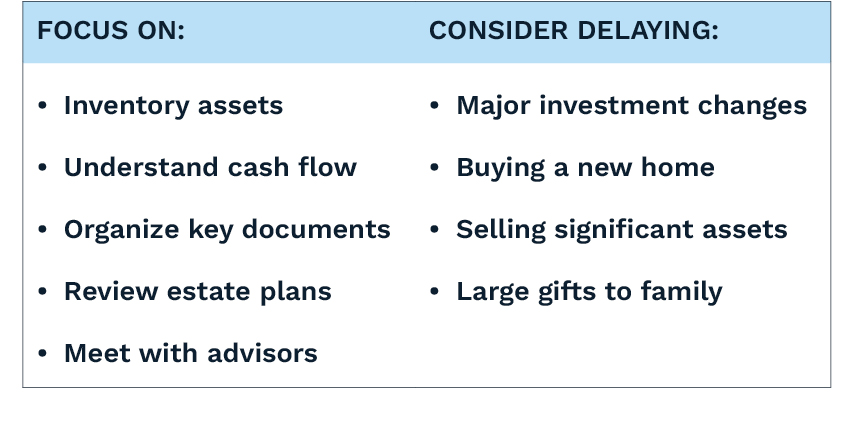
The first year after a major life transition is often the most emotionally and financially vulnerable period. The goal should be to create space for thoughtful decision-making.
Moving From Preservation to Purpose
The early stages of a transition are often about protection and preservation, but eventually the focus shifts to something larger: What do you want your wealth to accomplish? How should it support your family, your future, or the legacy you hope to leave behind?
The most successful transitions occur when women move beyond protecting assets and begin defining the purpose behind them. Wealth becomes a tool for creating security, independence, opportunity, and impact. That is where true financial confidence is built: not from knowing every answer, but from having a clear vision and a thoughtful plan.
Preparing Before the Transition Happens
The best time to prepare for a wealth transition is before one occurs, by understanding household finances, knowing where key documents are stored, and building relationships with trusted advisors today. For advisors, it also means engaging women as decision makers long before wealth changes hands. Waiting until after is often too late.
Women are poised to become the primary stewards of an extraordinary amount of wealth over the coming decade. The opportunity is not simply to inherit assets, but to lead them with intention. Whether you are building wealth, anticipating an inheritance, navigating widowhood, or facing another major life change, the goal is not perfection. It is preparedness.
Frequently Asked Questions
Why are more women becoming primary financial decision makers?
We are living through one of the largest wealth transfers in history. According to McKinsey & Company, women are projected to control much of the $30 trillion in financial assets currently held by Baby Boomers by 2030. Women also outlive men by nearly five years on average, making post-spouse financial leadership a likely reality for many married women.
What is the biggest financial challenge of widowhood?
Research from Merrill Lynch and Age Wave found that 69% of widows identified becoming the sole decision maker as the biggest financial challenge of widowhood. Only 14% were making financial decisions independently before their spouse’s death.
Who should be on a woman’s team of financial advisors?
A trusted circle of advisors often includes a financial advisor, attorney, and tax professional. Building that team before a major transition occurs creates structure during uncertainty, helps coordinate decisions, and provides a sounding board when emotions and finances become intertwined.
What should you focus on in the first year after a major wealth transition?
The first year is often the most emotionally and financially vulnerable period, so the goal should be to create space for thoughtful decision-making. Focus on inventorying assets, understanding cash flow, organizing key documents, reviewing estate plans, and meeting with advisors. Consider delaying major investment changes, buying a new home, selling significant assets, and large gifts to family.
Citations
1 Baghai, Pooneh, Olivia Howard, Lakshmi Prakash, and Jill Zucker. “Women as the Next Wave of Growth in U.S. Wealth Management.” McKinsey & Company, July 29, 2020.
2 Merrill Lynch and Age Wave. “Widowhood and Money: Resiliency, Responsibility, and Empowerment.” Bank of America Corporation, March 15, 2018.
Disclaimers
The opinions and analyses expressed in this presentation are based on Curi Capital LLC’s (“Curi Capital”) research and professional experience and are expressed as of the date of this presentation. Certain information expressed represents an assessment at a specific point in time and is not intended to be a forecast or guarantee of future performance, nor is it intended to speak to any future time periods. Curi Capital makes no warranty or representation, express or implied, nor does Curi Capital accept any liability, with respect to the information and data set forth herein, and Curi Capital specifically disclaims any duty to update any of the information and data contained in this presentation. The information and data in this presentation does not constitute legal, tax, accounting, investment, or other professional advice.
The content contained herein was generated by Curi Capital with the assistance of an AI-based system to augment the effort.
Certified Financial Planner Board of Standards, Inc. owns the certification marks CFP®, CERTIFIED FINANCIAL PLANNER™ and federally registered CFP (with flame design) in the U.S., which it awards to individuals who successfully complete CFP Board’s initial and ongoing certification requirements. CFA® and Chartered Financial Analyst® are registered trademarks owned by CFA Institute.