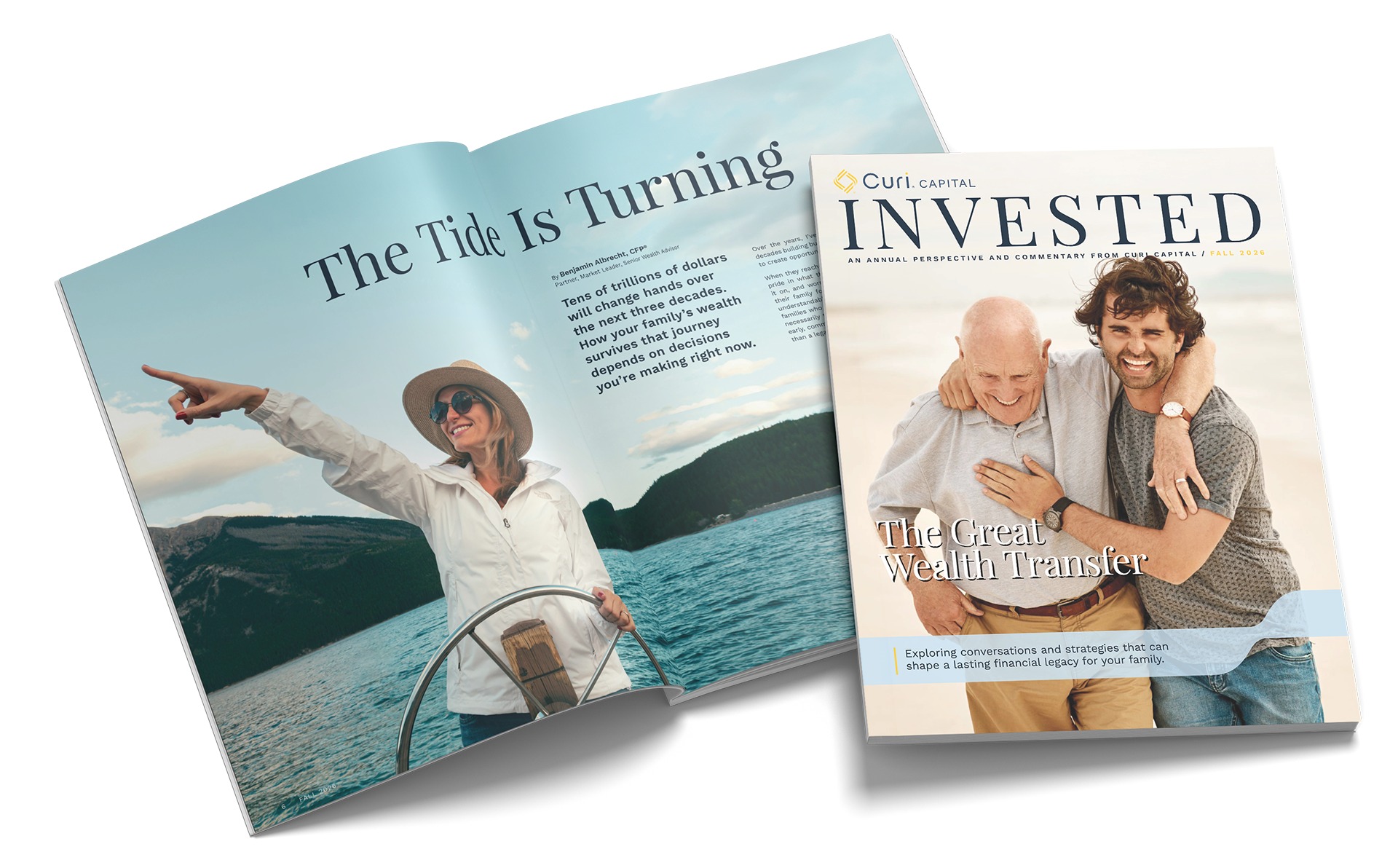
Tens of trillions of dollars will change hands over the next three decades. How your family’s wealth survives that journey depends on decisions you’re making right now.
Key Takeaways
- An estimated $84.4 trillion is expected to move between generations through 2045, one of the largest transfers of wealth in history.
- According to the Williams Group, 70% of family wealth is lost by the second generation, most often because of family dynamics and communication challenges rather than financial mistakes.
- Silence is costly. Only 14% of American adults have had detailed conversations about inheritance with their family.
- Prepared families talk openly about money, share their values, and introduce the next generation to financial concepts before they’re needed.
Over the years, I’ve worked with many families who spent decades building businesses, growing portfolios, and sacrificing to create opportunities for the next generation.
When they reach this stage, I see a familiar mix of emotions: pride in what they’ve built, uncertainty about how to pass it on, and worry that they haven’t done enough to prepare their family for what’s next. Those feelings are completely understandable. What I’ve learned, though, is that the families who navigate this transition most successfully aren’t necessarily the wealthiest. They’re the families who prepare early, communicate openly, and treat wealth transfer as more than a legal or financial event.
The Scale of What’s Moving
The numbers behind the Great Wealth Transfer are remarkable, and they are why we are witnessing one of the largest transfers of wealth in history.
According to Cerulli Associates, an estimated $84.4 trillion is expected to move between generations through 2045, with some projections placing that figure closer to $124 trillion by 2048.
For those who built this wealth, the scale of the moment deserves your full attention, not because something bad is about to happen, but because something significant is, and the shape it takes depends largely on the choices you make before the transfer begins.
Why Wealth Doesn’t Keep
An uncomfortable statistic has stayed with me for years: According to a landmark 20-year study by the Williams Group, 70% of family wealth is lost by the second generation. By the third, that figure climbs to 90%.
The conventional wisdom has a darkly comic summary: The first generation makes the money, the second spends it, and the third loses it.
What’s particularly interesting about the Williams Group research is that financial mistakes weren’t the primary reason wealth disappeared. In most cases, the root causes were family dynamics and communication challenges: lack of trust, unclear expectations, and heirs who inherited assets but never inherited the knowledge, confidence, or values needed to manage them well. In other words, wealth doesn’t fail to survive because of financial problems. It fails to survive because of human ones.
A comprehensive estate plan is necessary, but it’s not enough. The legal and financial architecture of a transfer can be flawless while the human foundation beneath it crumbles.
Silence Is Costly
Families often avoid talking about money, not because they don’t care, but because the conversations feel uncomfortable. Talking about inheritance means talking about mortality. It means discussing who gets what and acknowledging that the wealth holder won’t always be there.
But here is what I’ve learned: That silence works, until it doesn’t. It works until you die.
A 2025 study by Catalyst Advisory found that 47% of American adults are uncomfortable or very uncomfortable talking openly about inheritance with their family. More telling: only 14% have had detailed conversations about inheritance at all.
When wealth transfer happens without a shared understanding of values, intentions, and expectations, heirs are left to interpret. The legacy the wealth holder intended to leave can end up looking nothing like what actually survives.
What Prepared Families Do Differently
Successful wealth transfers are built on communication. Cerulli’s work shows that 81% of high-net-worth advisory practices identify family meetings and regular communication as the most effective wealth transfer strategy, above any specific tax tool or trust structure.
Prepared families talk about money: what it means, how it was built, and what it is and is not meant to do. They create shared language around values and introduce the next generation to financial concepts before they’re needed, preparing the heirs as much as the estate. They also plan, even though more than half of wealthy families lack a comprehensive succession plan, often because planning feels overwhelming and conversations feel risky.
“The question isn’t simply how much to leave, or when, or in what form. The deeper question is: What kind of wealth holder do you want your heir to become?”
Wealth Is More Than Money
I’ve noticed a quiet shift in how clients define what they want to transfer. What keeps people up at night is whether their wealth will have lasting meaning, whether it will enable the next generation to live purposefully, and whether the values that guided its creation will survive the transaction.
The deeper question is: What kind of wealth holder do you want your heir to become? That question has an answer, but it requires intention, conversation, and time.
Financial planning involves investment management, tax efficiency, estate strategies, and the technical disciplines that support long-term wealth preservation. But the families I work with are rarely asking only for technical expertise. They’re trying to balance financial goals with personal values, navigating decisions that may influence children, grandchildren, and generations they’ll never meet.
I think of this work as multigenerational strategy. The technical side matters, but so does helping families communicate effectively, align around shared goals, and develop a clear vision for what their wealth is meant to accomplish. When those pieces come together, families don’t simply transfer wealth. They transfer the knowledge, perspective, and responsibility needed to preserve it, the difference between wealth that lasts a generation and wealth that becomes a lasting family legacy.
Frequently Asked Questions
What is the Great Wealth Transfer?
The Great Wealth Transfer is the movement of wealth from one generation to the next over the coming decades. According to Cerulli Associates, an estimated $84.4 trillion is expected to move between generations through 2045, with some projections placing that figure closer to $124 trillion by 2048.
Why do families lose wealth after the first generation?
According to a 20-year study by the Williams Group, 70% of family wealth is lost by the second generation and 90% by the third. Financial mistakes weren’t the primary reason. In most cases, the root causes were family dynamics and communication challenges: lack of trust, unclear expectations, and heirs who inherited assets but never inherited the knowledge, confidence, or values needed to manage them well.
Is an estate plan enough to protect family wealth?
A comprehensive estate plan is necessary, but it’s not enough on its own. The legal and financial architecture of a transfer can be flawless while the human foundation beneath it crumbles. Cerulli’s work shows that 81% of high-net-worth advisory practices identify family meetings and regular communication as the most effective wealth transfer strategy, above any specific tax tool or trust structure.
How can families prepare the next generation to inherit wealth?
Prepared families talk about money: what it means, how it was built, and what it is and is not meant to do. They create shared language around values, introduce the next generation to financial concepts before they’re needed, and plan early, preparing the heirs as much as the estate.
Disclaimers
The opinions and analyses expressed in this presentation are based on Curi Capital LLC’s (“Curi Capital”) research and professional experience and are expressed as of the date of this presentation. Certain information expressed represents an assessment at a specific point in time and is not intended to be a forecast or guarantee of future performance, nor is it intended to speak to any future time periods. Curi Capital makes no warranty or representation, express or implied, nor does Curi Capital accept any liability, with respect to the information and data set forth herein, and Curi Capital specifically disclaims any duty to update any of the information and data contained in this presentation. The information and data in this presentation does not constitute legal, tax, accounting, investment, or other professional advice.
The content contained herein was generated by Curi Capital with the assistance of an AI-based system to augment the effort.
Certified Financial Planner Board of Standards, Inc. owns the certification marks CFP®, CERTIFIED FINANCIAL PLANNER™ and federally registered CFP (with flame design) in the U.S., which it awards to individuals who successfully complete CFP Board’s initial and ongoing certification requirements. CFA® and Chartered Financial Analyst® are registered trademarks owned by CFA Institute.