
For decades, private markets were largely reserved for institutional and ultra-high-net-worth investors. That is starting to change.
Key Takeaways
- Over the past two decades, the number of U.S. publicly traded companies has roughly halved while private equity-backed companies have grown nearly fivefold.
- An evergreen fund is an open-ended vehicle with no fixed end date, and it is usually fully invested from day one.
- Most evergreen funds offer monthly subscriptions and quarterly repurchases, but liquidity is limited. Repurchases are usually capped around 5% of fund shares per quarter and may be limited or suspended during market stress.
- Curi Capital views evergreen funds as a core private markets allocation and a complement to traditional drawdown funds. The right allocation depends on each investor’s time horizon, liquidity needs, risk tolerance, and broader financial goals.
Over the past two decades, the number of U.S. publicly traded companies has roughly halved while private equity-backed companies have grown nearly fivefold, shifting more corporate growth outside the public markets. One structure that has gained significant traction with the major asset managers now serving individual investors is the evergreen fund.
What Is an Evergreen Fund?
An evergreen fund is an open-ended vehicle with no fixed end date, operating continuously rather than moving through the fundraising, investment, and liquidation phases of a traditional drawdown fund.
Exit proceeds are typically reinvested rather than distributed, so capital stays invested and compounds over time. Investors generally buy in and redeem at the fund’s net asset value (NAV), subject to its liquidity terms.
How Evergreen Funds Work
Evergreen funds are usually fully invested from day one, so investors gain immediate exposure to an existing portfolio rather than waiting years for capital to be drawn down.
Subscriptions are typically monthly at NAV, and most funds offer quarterly repurchase opportunities. Liquidity is not unlimited; however, repurchases are usually capped around 5% of fund shares per quarter and may be limited or suspended during market stress.
Where They Fit
At Curi Capital, we view evergreen funds as a core private markets allocation and a complement to traditional drawdown funds. They can offer new investors an accessible entry point while giving existing private market investors added diversification and simpler cash-flow management. As always, the right allocation depends on an investor’s time horizon, liquidity needs, risk tolerance, and broader financial goals.
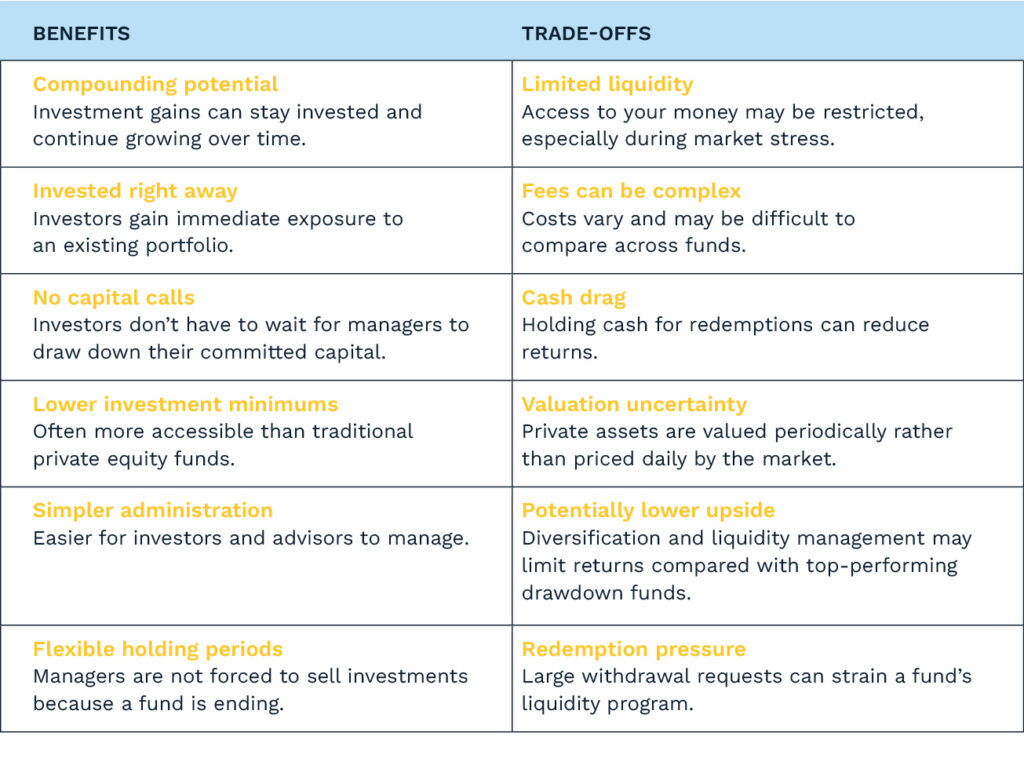
Evergreen Funds: Benefits and Trade-Offs
Are Evergreen Funds Right for You?
At Curi Capital, we believe evergreen funds are one of the most important developments in private markets investing in recent years, opening the door to an asset class once out of reach for many investors. No structure is without trade-offs, but for investors with a long-term perspective, they can be a valuable tool for building exposure. Your Curi Capital advisor can help evaluate how they may fit alongside your other investments.
Frequently Asked Questions
What is an evergreen fund?
An evergreen fund is an open-ended vehicle with no fixed end date. It operates continuously rather than moving through the fundraising, investment, and liquidation phases of a traditional drawdown fund. Exit proceeds are typically reinvested rather than distributed, so capital stays invested and compounds over time.
How is an evergreen fund different from a traditional drawdown fund?
Evergreen funds are usually fully invested from day one, so investors gain immediate exposure to an existing portfolio rather than waiting years for capital to be drawn down. Investors generally buy in and redeem at the fund’s net asset value (NAV), subject to its liquidity terms.
How liquid are evergreen funds?
Subscriptions are typically monthly at NAV, and most funds offer quarterly repurchase opportunities. Liquidity is not unlimited, however. Repurchases are usually capped around 5% of fund shares per quarter and may be limited or suspended during market stress.
What are the trade-offs of evergreen funds?
Trade-offs include limited liquidity, fees that can be complex and difficult to compare across funds, cash drag from holding cash for redemptions, valuation uncertainty, potentially lower upside compared with top-performing drawdown funds, and redemption pressure from large withdrawal requests. The right allocation depends on an investor’s time horizon, liquidity needs, risk tolerance, and broader financial goals.
Disclaimers
The opinions and analyses expressed in this presentation are based on Curi Capital LLC’s (“Curi Capital”) research and professional experience and are expressed as of the date of this presentation. Certain information expressed represents an assessment at a specific point in time and is not intended to be a forecast or guarantee of future performance, nor is it intended to speak to any future time periods. Curi Capital makes no warranty or representation, express or implied, nor does Curi Capital accept any liability, with respect to the information and data set forth herein, and Curi Capital specifically disclaims any duty to update any of the information and data contained in this presentation. The information and data in this presentation does not constitute legal, tax, accounting, investment, or other professional advice.
The content contained herein was generated by Curi Capital with the assistance of an AI-based system to augment the effort.
CFA® and Chartered Financial Analyst® are registered trademarks owned by CFA Institute.